

The moment young animals go outside for the first time is always special. For foals, calves and lambs, it means freedom, space and new stimuli. Because these animals have no experience of being out in the field, extra care is needed when preparing them. A fence that works well for adult animals is not automatically suitable for young animals that still need to learn their boundaries. In this blog, you can read what you, as an animal keeper, need to pay attention to in order to safely and controlledly let young horses, cows and sheep outside for the first time.
Why young animals require a different approach
Young animals behave differently from adult animals. They are curious, playful and less cautious. Whereas adult animals often respect the fence, young animals do not yet do so. They may bump into the wire, try to crawl under it or run through it and escape. That is why it is important that the fence is in good condition from the outset. The first experience determines how an animal will respect the fence in the future.

The basics must be right before the first grazing
The first step is always to adapt the fence to the behaviour and size of young animals. The fence must make sense to them. This means that they must see and understand the fence and not be able to unintentionally ignore or pass it. Visibility plays a major role in this. Young animals recognise a clear line more quickly than a thin wire that blends into the environment.
This is especially important for young horses and foals. Foals move around a lot and sometimes react unexpectedly. The fence must therefore not only be clearly visible, but also safe. Materials that pose a risk of cuts or injuries, such as wire, are best avoided. Multiple lines at different heights ensure that a foal recognises the fence before accidentally running under or into it.
Calves and young cows require a different approach than horses or sheep. They are less skittish, but more inquisitive and physical, and often engage in testing boundaries as a group. If one animal puts pressure on the fence, others will usually follow. That is why it is important that the fence is set up correctly from the start and provides sufficient voltage. The fence must be set up in such a way that calves cannot crawl under it or push against it with their bodies.
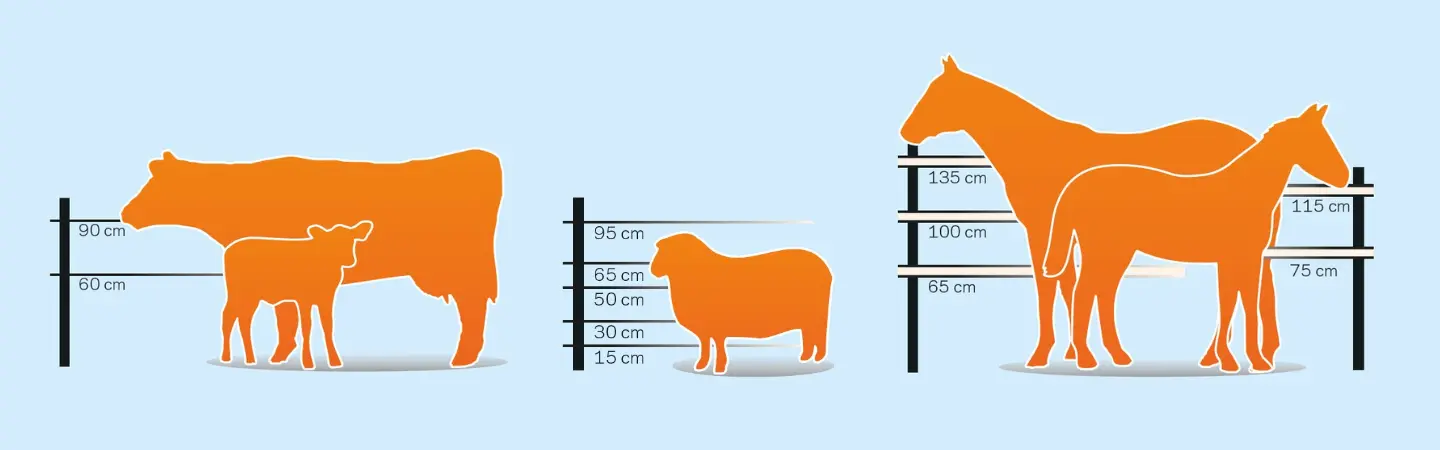
Size plays a major role with lambs and young sheep. They are small, agile and curious. If the fence is not properly adjusted, they will crawl under or between the wires before they have even learned that it is a boundary. That is why the design is at least as important as the voltage itself. Sheep are less sensitive to electric fence due to their insulating wool. Sufficient voltage is therefore extra important.
Do you have everything in order for your animal? Then start by checking the voltage on the wire. This must be at least 3.5 kV. Young animals must immediately feel that the fence is a clear boundary. Then check the earthing. Especially in dry periods, an inadequate earthing system can cause the fence to work less effectively. Vegetation along the fence also deserves attention. Grass, weeds and branches that touch the wire reduce the voltage on the wire due to short circuits. Check the fence and clear it before the animals go outside. All the points you need to get the pasture ready for grazing can be found in the handy Gallagher Check.

Introduce young animals in a controlled manner
A frequently asked question is whether young animals can be put straight into the large pasture. The answer is that a controlled introduction often works better. Many animal keepers choose to let young animals get used to the electric fence in a small training pasture or paddock first. In a quiet environment, animals can see the wire better, explore it and touch it for the first time. A shock at a quiet moment is much more educational than when it happens during a collision, for example, or when the animal runs through the wire in excitement.
With sheep and lambs, it is wise to let this introduction take place while they are walking with their mothers. Lambs copy the behaviour of the ewes and learn more quickly that the fence must be respected. Observe the animals closely during the first few hours and days.
Keep checking and adjusting
The first few weeks after going outside are crucial. Walk along the fence regularly, measure the voltage and observe the behaviour of the animals. If their behaviour changes, this is often a sign that something is wrong. Even after a period in the barn or after winter, it may be necessary to let the animals get used to it again. Young animals grow quickly and their behaviour changes.